What Is WETH? A Simple Guide for Beginners
If you have used DeFi for more than a few minutes, you have probably seen both ETH and WETH in the same wallet. This guide explains what WETH is, why people wrap ETH in the first place, and how wrapped tokens fit into everyday swaps and DeFi activity.
ETH Versus WETH in One Sentence
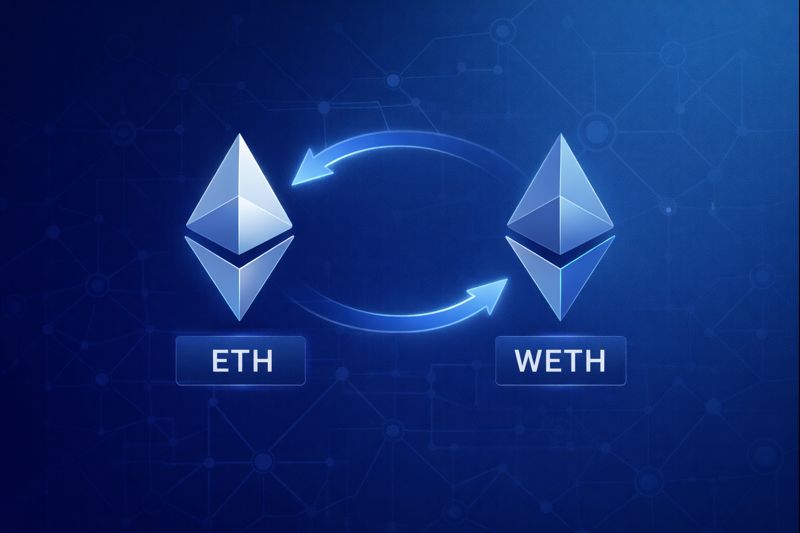
ETH is the native currency of networks like Ethereum and many related chains, while WETH is a token that represents ETH in a form that smart contracts can handle more easily.
You can think of WETH as a tokenized receipt that says, “one unit of this WETH can always be redeemed for one unit of real ETH.” This relationship is designed to stay one to one.
If you are not yet familiar with how token swaps work in general, it may help to read our explainer on
what a token swap is and how it works
as a starting point.
What It Means for a Token to Be Wrapped
A wrapped token is a token that represents another asset in a different form. Wrapping usually means locking the original asset inside a smart contract, then issuing a new token that can be moved or traded more easily.
In the case of WETH, users send ETH into a wrapping contract. The contract holds the ETH and issues WETH back to the user. When the user wants to go back to regular ETH, the contract takes in WETH and returns ETH.
The key idea is that the wrapped version should always track the value of the original. One WETH is designed to be worth one ETH, in the same way that one unit of a good stablecoin is designed to be worth one dollar. If you want an example of that, you can read our introduction to
what USDC is and how it works.
Why WETH Exists at All
At first glance, WETH may look redundant. After all, if ETH already exists, why create another version of it?
The answer comes from how smart contracts and tokens were designed. ETH is the native asset of the network, and it is handled differently from regular tokens. Most DeFi protocols, however, are built around a common token standard. On Ethereum and many related chains this standard is known as ERC 20.
ETH itself is not an ERC 20 token. That difference made it harder for early DeFi protocols to support ETH in the same way as other tokens. WETH solved this problem by providing an ERC 20 version of ETH. Once ETH is wrapped, smart contracts can treat it just like any other token inside pools, lending markets, and routing paths.
How Wrapping and Unwrapping WETH Works
From a user perspective, wrapping ETH into WETH is simple. You send ETH to a wrapping contract, and it sends you back the same amount of WETH. Unwrapping works in the opposite direction. You send WETH to the contract, and it returns ETH to your wallet.
Some wallets and DeFi front ends provide a built in “wrap” and “unwrap” button. Under the surface, these are just convenient ways of sending the correct transactions to the wrapping contract.
Each time you wrap or unwrap, you pay a small amount of gas. On lower cost networks, this fee is usually minimal, although it is still worth paying attention to the network conditions you are using.
Where WETH Lives and How It Becomes Multi Chain
The original WETH contract lives on Ethereum. Over time, similar contracts have been deployed on many other networks, including Base, Arbitrum, Polygon, and others. On each network, WETH represents that network’s version of native ETH for DeFi purposes.
In addition, some networks use bridged versions of WETH that represent ETH that was moved across a bridge. The details vary from bridge to bridge, but the idea is the same. Real ETH is locked on one side, and a wrapped version appears on the other. When users move back, the wrapped version is destroyed and the original is released.
This is one reason it is important to pay attention to which version of WETH you are using, especially when you move between chains or bridges.
Why WETH Is So Common in DeFi
WETH shows up in many DeFi applications because it behaves like an ERC 20 token while representing the most widely used asset in the ecosystem. That combination makes it a natural choice for liquidity pools.
Many trading pairs are structured as token to WETH. For example, a protocol may offer a pool that trades USDC against WETH instead of USDC against raw ETH. This structure makes pricing and accounting simpler for the contracts involved.
WETH also appears frequently in swap routing. Aggregators that search for the best path may route part of your trade through a WETH pair, because those pools are often the deepest. If you want a better understanding of why depth matters and how it affects pricing, you may find our article on
DeFi slippage explained
useful.
Risks and Details to Be Aware Of
WETH is widely used and battle tested, but it still involves a few risks and details that are worth understanding.
- Smart contract risk: WETH depends on the correctness of its wrapping contract. The original contracts have a long track record, but in general any smart contract carries some risk.
- Bridge risk: Bridged versions of WETH depend on the security of the bridge. A problem with the bridge can affect the value of the wrapped asset on the other side.
- Confusion risk: There can be multiple WETH like tokens on a network, some official and some created for specific protocols. It is important to verify that you are interacting with the correct contract.
- Gas costs: Wrapping and unwrapping use transactions, and each transaction consumes gas. On very busy networks, these costs can add up.
For a broader view of staying safe while using DeFi tools, you can review our
beginner safety toolkit for DeFi,
which covers habits that help reduce risk regardless of which tokens you use.
How WETH Fits Into Your On Chain Activity
For most users, WETH is not something to fear. It is simply a more flexible form of ETH that plays nicely with DeFi protocols. Many traders keep a portion of their ETH wrapped so they can provide liquidity, trade efficiently, or move through routes that rely on WETH based pools.
When you look at your wallet, you can treat WETH and ETH as two representations of the same value. The choice between them mostly depends on whether you are using a protocol that expects a regular token format or not.
If you want to see how WETH appears in a real transaction, our guide on
reading a DeFi transaction
walks through what happens on an explorer when a swap uses WETH behind the scenes.
Ready to see WETH in action?
Open the Brick Chain app, connect a wallet, and request a small quote on a WETH pair. You will see routing paths, expected output, and price impact before you confirm any trade.