How to Set Slippage Tolerance Safely (and When Higher Is Worse)
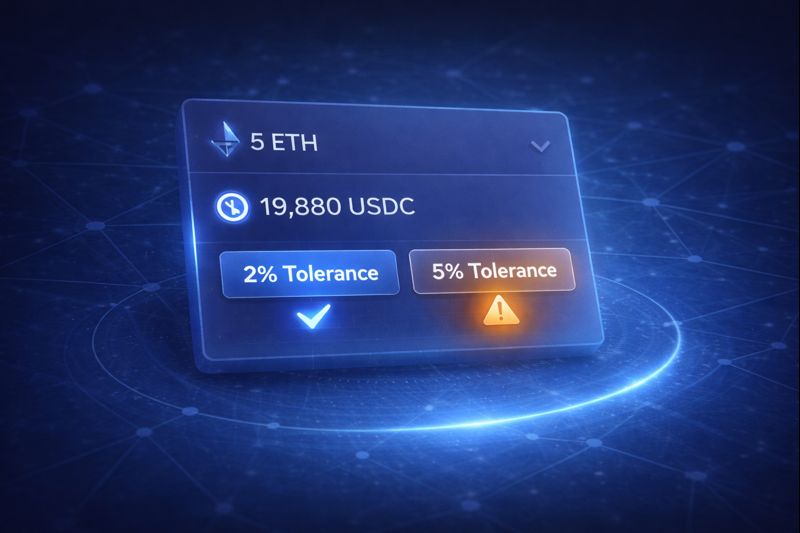
Slippage tolerance is one of the few settings traders can actively control in DeFi, yet it’s often misunderstood or ignored. Many users raise it to “make the trade go through” without realizing they are quietly increasing execution risk. This guide explains how slippage tolerance actually works, how to set it responsibly, and why higher values can sometimes lead to worse outcomes rather than safer ones.
What Slippage Tolerance Actually Controls
Slippage tolerance defines the maximum price movement you are willing to accept between the quoted price and final execution. It does not improve pricing. It does not reduce volatility. It simply sets a boundary for when a transaction should fail instead of executing at an unexpectedly worse rate.
In practical terms, slippage tolerance is a permission setting. You are telling the protocol, “If conditions change beyond this threshold, do not complete the trade.” When set thoughtfully, it protects you from unfavorable execution. When set carelessly, it removes an important safeguard.
Why Slippage Tolerance Exists in the First Place
On-chain trades are not executed instantly. Between the moment you sign a transaction and the moment it is confirmed, several things can change: pool balances shift, prices move, or routing paths adjust. Slippage tolerance exists to account for this uncertainty.
Without a tolerance limit, every trade would either fail at the slightest movement or expose users to unlimited price drift. The tolerance is the compromise, giving trades room to complete while still enforcing a ceiling on acceptable deviation.
The Common Mistake: Raising Slippage to Force Execution
A frequent pattern among newer DeFi users is increasing slippage tolerance after a transaction fails. At first glance, this feels logical. If the trade did not go through, allow more flexibility. The problem is that this approach treats symptoms, not causes.
Failed swaps usually indicate one of three conditions: low liquidity, rapid price movement, or inefficient routing at that moment. Raising slippage does not fix any of these. It simply allows the trade to execute even if conditions deteriorate further.
In calm markets, this may go unnoticed. In volatile or thin markets, it can result in execution far worse than expected.
When Higher Slippage Is Actually Worse
Higher slippage tolerance increases exposure to adverse price movement. This matters most in situations where the market is unstable or liquidity is uneven across pools.
- Volatile assets: Prices can move sharply within seconds, and higher tolerance allows execution at the tail end of that move.
- Thin liquidity: A large tolerance may permit execution deep into a pool’s curve, dramatically worsening price impact.
- Fast-moving markets: Slippage tolerance can unintentionally absorb multiple small price shifts into one poor execution.
In these scenarios, a failed transaction is often preferable to a completed one at an unexpectedly poor rate.
How to Set Slippage Tolerance by Asset Type
There is no single “correct” slippage tolerance. The appropriate setting depends on the asset pair and market conditions.
- Highly liquid pairs: 0.1% to 0.3% is typically sufficient.
- Moderately liquid or volatile tokens: 0.5% to 1% may be reasonable.
- Illiquid or newly launched assets: Higher tolerance may be required, but risk increases materially.
The key is not maximizing execution probability. It is balancing execution probability against acceptable downside.
Why Failed Transactions Are Not Always a Bad Outcome
In traditional finance, failed trades feel like errors. In DeFi, they are often protective. A failed transaction means the system refused to execute outside the boundaries you set.
Especially on low-fee networks like Base, failed swaps can serve as signals. They indicate that conditions are unfavorable at that moment and encourage reassessment rather than blind continuation.
Slippage Tolerance and Routing Quality
Routing plays a significant role in how often slippage thresholds are tested. Aggregators split orders across multiple pools to reduce price impact, which can allow lower tolerances to succeed.
When routing is inefficient or liquidity is fragmented, trades are more likely to brush against tolerance limits. In these cases, improving routing quality is preferable to relaxing safeguards.
Practical Slippage Discipline for Everyday Traders
- Start low. Use conservative tolerances by default.
- Observe failures. Failed swaps are information, not inconvenience.
- Adjust timing. Retry during higher liquidity periods rather than raising tolerance immediately.
- Split size. Large trades often execute more efficiently when broken into smaller ones.
- Verify quotes. Always review expected and minimum received amounts before confirming.
How Brick Chain Approaches Slippage Settings
Brick Chain is designed to make slippage visible and understandable. Users see quoted output, minimum received, and routing context before execution. This allows slippage tolerance to be an informed choice rather than a guess.
By combining transparent routing with Base’s low transaction costs, Brick Chain enables users to test settings, learn from outcomes, and refine execution habits without excessive friction.
The Takeaway
Slippage tolerance is not a lever to force trades through. It is a safety boundary. Used thoughtfully, it protects execution quality and encourages disciplined decision-making. Used carelessly, it can quietly erode outcomes.
In DeFi, control comes with responsibility. Understanding how to set slippage tolerance safely is part of trading with clarity rather than impulse.
Want clearer execution before you swap?
Use Brick Chain to review routes, expected output, and minimum received before every trade.
Also published on Medium for discussion and community insights.